Playing online baccarat isn’t much different from playing baccarat in a land-based casino. The only difference is that it is more inclusive in an online casino, since you can circumvent high minimum bets and dress codes.
Just like in a “real” casino, there’re only three outcomes in online baccarat, the player wins, the banker wins or there’s a tie. Just like offline, the dealer (or the computer) does pretty much all the work in online baccarat.
Understanding the Baccarat Table Layout
The table layout of a baccarat table is fairly simple. Since there’re only three outcomes, that is all you need to put on the table.
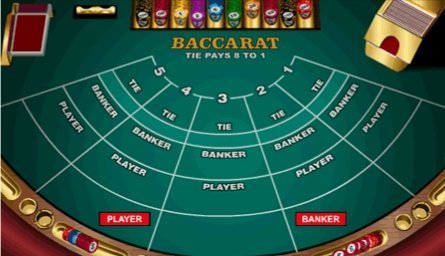
Full-sized baccarat tables can usually be found in secluded areas of the casino floor in a land-based casino, since it is mostly used to attract high rollers and the table limits can be incredibly high.
A baccarat table is oval and comes with yellow numbers on each side. The numbers go from 1 to 15 with the 13 being skipped for reasons of superstition. In some oriental cultures the number 4 is considered unlucky and will therefore sometimes be skipped instead or as well.
On one side of the baccarat table, there will be a cutout in the shape of a “u” that is supposed to give a place for the dealer to stand (this can be skipped in online baccarat, obviously).
What you will see at the place where you’re sitting is a field with your three outcomes (banker, player, tie) and places for you to place your chips on the outcome you predict.
It’s as simple as that. A full-sized baccarat table usually has place for 14 players and three dealers (one of them is the caller and they rotate). Each player has fields in front of them to place their chips on one of the three outcomes. The middle of the table is reserved for the dealers and it helps them keep track of all the bets and it is also where the caller deals the hands.
Mini Baccarat Layout
The mini-baccarat table is basically a full-sized one cut in half. There’s only space for up to 7 players and it also only needs one dealer. but that is where the differences end already. The only other thing is that the bet sizes are usually also lower on the mini tables.
Seeing those differences, the mini table is where you’ll want to start off if you’re new to the game of online baccarat. Things are just a little simpler here.
Understanding Card & Hand Values in Baccarat
The question of card values in baccarat has a fairly straight-forward answer. All cards 2 to 9 are worth their face value, so a 7 would be worth 7 points and so on.
Tens, jacks, queens and king are all worth nothing and the ace is worth one point. Your hand of two cards has the value of the rightmost digit of its added value. So, if you have a hand of jack (which is worth zero) and a 7, your hand would be worth seven points. If your hand consists of a seven and a five, however this would add up to 12 points and so your hand would only be worth 2 points, since that is the rightmost digit. Easy enough, isn’t it?
Getting Familiar with Basic Baccarat Terminology
In order to properly understand online baccarat, you’ll have to familiarize yourself with some of its terminology. But fret not, we’re here to help with a handy dictionary of the most important baccarat terms!
Burning is the removal of the top 3 to 6 cards before the game starts. This is done right after shuffling.
Caller is the dealer that is responsible for dealing the hands at your baccarat table.
Coup is a French word that describes a round of baccarat with both a banker hand and a player hand.
Loss bet is a bet against the bank.
Natural is when your two received cards add up to either 8 or 9.
Shoe is the box that holds the cards and from which the cards are dealt.
Tie bet is when the dealer and the player get the same amount of points. Neither hand wins in this case.
Understanding the Order of Play in Baccarat
The first thing you’ll have to do in a game of online baccarat is decide which outcome the next hands will result in. You have three choices, bet on the banker, the player or a tie.
After that the two hands are dealt by the dealer. The player hand and the banker hand. The cards will then be turned face up and the next moves are determined. If either player or banker card get a value of 8 or 9, that hand wins and the bets are paid out.
There are, however some situations when further action is required. If the player’s hand is worth between 0 and 5 points, an additional third card is dealt.
If the player drew a third card, the banker has some rules to follow for his own hand.
- If his total is 2 or less, the banker draws a third card, no matter what the player’s third card was
- If the total is 3, a third card is drawn if the player’s third card wasn’t an 8
- If the total is 4, a third card is only drawn if the player’s third card was 2, 3, 4, 5, 6 or 7
- If the total is 5, a third card is only drawn if the player’s third card was 4, 5, 6 or 7
- If the total is 6, a third card is only drawn if the player’s third card was 6 or 7
- And the banker will have to stand if his total is 7
After all those shenanigans, bets are finally paid out. Bets are paid out as even money on player bets and 95% of even money on banker bets with a 5% house commission. In the case that player and bank have a hand of the same value, all bets on tie are paid out 8 to 1 and all bets on player or banker stay in place for the next game. Although, depending on casino rules, players might also be able to retract these bets.
To summarize:
- Baccarat is played with 6 to 8 decks of 52 cards. Card values are 1 for Ace, 2 to 10 hold face value, all face cards are valued at 10.
- The game starts once bettors have placed a wager on Player, Banker, or Tie.
- Scores are calculated with added value of cards together and only using the second digit for values over 10.
- Additional cards are not given when either the Player or Banker hand has 8 or 9.
- Additional cards are given to hands with values lower than 6.
- Only 1 additional card can be added to a hand to increase the value









 can afford to lose when push comes to shove.