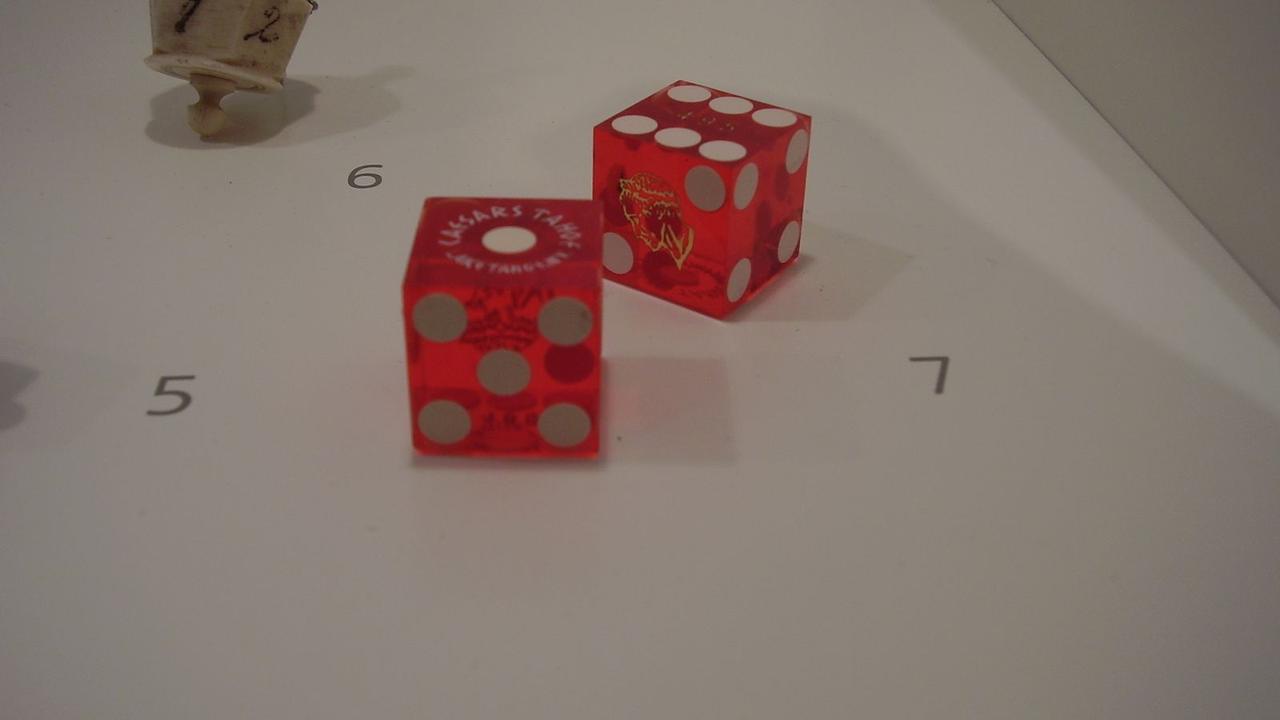
Most table games are not mentioned by name in the Criminal Code. Blackjack, baccarat and roulette fall under general words such as "game of chance". Dice are different. The phrase "dice game" appears expressly in three places in Part VII, and each time it narrows who may offer the game. The result is a rule many casual players never notice: in Canada, a casino-style dice game for money is something a provincial government may conduct and manage, while a charity, a fair board or a licensed amusement operator may not.
This article reads those provisions in order. It is an explanation of the statute, not legal advice for any event or venue.
Where dice appear in Part VII
| Provision | What it says about dice | Effect |
|---|---|---|
| s.206(1)(g) | Offence to induce any person to stake money or valuable property on the result of any dice game | Dice wagering is a named offence, unless an exception applies |
| s.206(3) | Fair and exhibition exception does not extend to dice games | Fair boards and their concessionaires cannot rely on it for dice |
| s.207(4)(c) | For paras (1)(b) to (f), a lottery scheme does not include a game operated on or through a dice game | Charities, fairs, amusement licensees and other non-government operators cannot be licensed for dice games |
| s.207.1(4) | Cruise-ship definition of lottery scheme has no dice exclusion | Dice games may run on a qualifying international cruise |
Section 206(1)(g): dice by name
Subsection 206(1) is the general offence for lotteries and games of chance. Paragraph (g) makes it an offence to induce "any person to stake or hazard any money or other valuable property or thing on the result of any dice game, three-card monte, punch board, coin table or on the operation of a wheel of fortune". The penalty is the same as for the rest of subsection (1): imprisonment for up to two years on indictment, or a summary conviction offence.
Paragraph (g) groups dice with a short list of named games, including three-card monte, which subsection 206(2) defines broadly to include similar games "whether or not played with cards". The statute does not explain why dice were singled out, and this article does not guess. What matters is the effect: a dice game for money is, by default, an offence, and only a specific exception takes it out.
The fair and exhibition exception stops at dice
Subsection 206(3) gives a limited exception to the board of an annual fair or exhibition and to concessionaires operating on its grounds during the event. Paragraphs (1)(f) and (g) do not apply to them, "in so far as they do not relate to a dice game, three-card monte, punch board or coin table". In plain terms, a midway wheel of fortune or a game of mixed chance and skill may fall within the exception, but a dice game for stakes does not. Subsection 206(3.1) adds that a fair or exhibition means an event where agricultural or fishing products are presented or where activities relating to agriculture or fishing take place.
Section 207(4)(c): the licensing exclusion
Section 207 lists who may lawfully conduct and manage a "lottery scheme". Paragraph (1)(a) covers the government of a province, alone or with other provinces. Paragraphs (1)(b) to (f) cover others, in particular:
- charitable or religious organizations licensed by the province, where proceeds go to charitable or religious objects (para. (b));
- the board of a fair or exhibition, or a concessionaire, licensed by the province (para. (c));
- a licensee at a public place of amusement, with each prize capped at five hundred dollars and each chance at two dollars (para. (d));
- inter-provincial arrangements and schemes authorized in another province (paras. (e) and (f)).
Subsection 207(4) then defines "lottery scheme". Paragraph (c) provides that, for the purposes of paragraphs (1)(b) to (f), the term does not include a game "operated on or through a computer, video device, slot machine or a dice game". Because paragraph (1)(a) is not on that list, the exclusion does not bind provincial governments.
The consequence is a two-tier system. A province may conduct and manage craps, sic bo or any other dice game, directly or through the corporation it uses to run casinos. A charity cannot be licensed to run one, however well-intentioned the cause, and neither can a fair board or an amusement operator. Our overview of gambling regulation in Canada explains how provinces use paragraph (1)(a) in practice.
The same clause covers slots and video games
Paragraph 207(4)(c) treats dice alongside computers, video devices and slot machines. That is why electronic gaming machines in Canada are run by provinces, and why a charity raffle may use computers only within the narrow carve-out added in subsection (4.1).
What the point-in-time versions show
The Justice Laws Website keeps earlier versions of section 207. They show that the dice exclusion is not a recent addition and has stayed stable while the text around it changed:
- The earliest version on the site, starting January 1, 2003, already contains the clause: for the purposes of paragraphs (1)(b) to (f), the exclusion covered a game operated on or through a computer, video device or slot machine within the meaning of subsection 198(3), "or a dice game".
- The version in force from December 16, 2014 adds subsection (4.1), allowing charities licensed under paragraph (1)(b) to use a computer for ticket sales, winner selection and prize distribution in a raffle, including a 50/50 draw (S.C. 2014, c. 39, s. 171). Dice were not touched.
- The version in force from December 13, 2018 replaces the cross-reference to subsection 198(3) with a new definition of "slot machine" in subsection (4.01) (S.C. 2018, c. 29, s. 17). The dice wording stayed.
- The version in force from August 27, 2021 narrows paragraph (4)(b) from bets on "any race or fight, or on a single sport event or athletic contest" to bets on "any horse-race" (S.C. 2021, c. 20, s. 2), which allowed provinces to offer single-event sports betting. Paragraph (4)(c) on dice was again left as it was.
The amendment history of section 207 also lists S.C. 1999, c. 5, s. 6. The site's point-in-time archive does not reach back to that change, so this article does not describe what it did.
Private games among friends
Part VII does not make every roll of dice for money a crime. The offences are aimed at schemes, inducements and gaming houses. Section 197 defines a "common gaming house" as a place kept for gain to which persons resort to play games, or a place used for games in which a bank is kept by some but not all players, the keeper takes a share of the bets, a fee is charged to play, or the chances are not equally favourable to all players. A game in someone's home with no house cut, no fee, no bank and equal odds falls outside that definition on its face. Where any of those elements creeps in, the analysis changes, and the relevant provisions are serious ones.
The cruise-ship exception
Section 207.1 lets the operator of an international cruise ship run a lottery scheme on a qualifying voyage, subject to conditions including a five-nautical-mile limit around Canadian ports of call. Its definition of "lottery scheme" excludes three-card monte, punch boards, coin tables and race or sports bookmaking, but contains no dice exclusion. On the text, a shipboard craps table is permitted when the voyage conditions are met.
What this means for players
- If you want to play craps or sic bo for money in Canada, the lawful venue is a provincially conducted and managed casino or the province's own gaming platform. Our guide to Canadian land casinos covers the venues.
- A charity "casino night" advertising real-money dice games sits outside what paragraph 207(1)(b) can authorize.
- A fair midway game involving dice for prizes cannot rely on the subsection 206(3) exception.
Casino gaming in Canada is restricted to adults: 19 and over in most provinces, and 18 and over in Alberta, Manitoba and Quebec. Dice games are fast, and the house edge varies sharply between bets. Our responsible gaming page lists limit-setting tools and provincial helplines.
Questions readers ask
Can a charity run craps at a fundraising casino night?
Not under a charitable licence. Paragraph 207(4)(c) of the Criminal Code excludes dice games from the lottery schemes that may be licensed under paragraphs 207(1)(b) to (f), which include charitable and religious organizations.
Who can lawfully offer craps in Canada?
A provincial government, alone or with other provinces, conducting and managing the game under paragraph 207(1)(a). The dice exclusion in s.207(4)(c) does not apply to that paragraph.
Do fair boards have an exception for dice?
No. Subsection 206(3) exempts fair boards and their concessionaires from paragraphs 206(1)(f) and (g) only in so far as those paragraphs do not relate to a dice game, three-card monte, punch board or coin table.
Is the dice exclusion new?
No. The earliest point-in-time version of s.207 on the Justice Laws Website, from January 1, 2003, already contains it, and later amendments to the section left it unchanged.
Are dice games allowed on cruise ships?
The cruise-ship definition of lottery scheme in s.207.1(4) has no dice exclusion, so dice games may run on a voyage that meets all the section's conditions.
Sources
- Criminal Code, s.206, Offence in relation to lotteries and games of chance (Justice Laws Website)
- Criminal Code, s.207, Permitted lotteries, current version (Justice Laws Website)
- Criminal Code, s.207, version from January 1, 2003 (Justice Laws Website)
- Criminal Code, s.207, version from December 16, 2014 (Justice Laws Website)
- Criminal Code, s.207, version from December 13, 2018 (Justice Laws Website)
- Criminal Code, s.207, version from August 27, 2021 (Justice Laws Website)
- Criminal Code, s.197, Definitions for Part VII (Justice Laws Website)
- Criminal Code, s.207.1, International cruise ship exemption (Justice Laws Website)
Related on CasinoTrust
- How to Play Craps Online and Win Money
- How to Play Sic Bo Online and Win Money
- Gambling Regulations in Canada
- Top 10 Canadian Land Casinos
- Responsible Gambling in Canada
More from the blog
 Charity lotteriesChase the Ace in Canada: how the draw works and why it needs a licenceA weekly ticket draw, a shrinking deck of cards and a jackpot that grows until someone turns over the ace of spades.
 Charity lotteries50/50 draws in Canada: the law, how the pot is split, and online 50/50sHalf the ticket money goes to the winner, half to the cause.
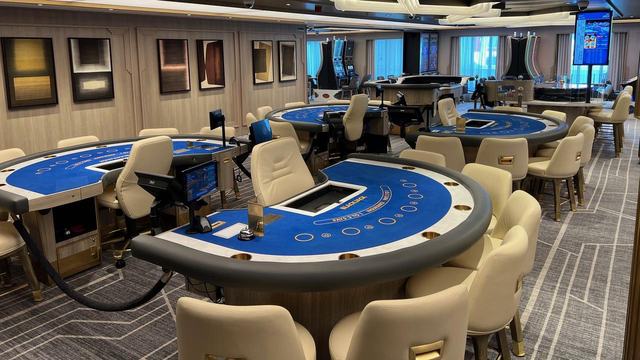 LawCruise ship casinos and Canadian waters: what section 207.1 of the Criminal Code allowsShip casinos are not a grey zone in Canada.
 RacingWhy horse racing bets are federal in Canada: pari-mutuel wagering and section 204Almost every form of legal gambling in Canada belongs to the provinces.